SACSCOC Workforce Initiative
Connecting higher education to careers.
SACSCOC Workforce Initiative | Supported by a grant from Lumina Foundation
The workforce gap won’t close by itself. We’re creating infrastructure to bridge it.
SACSCOC has launched a two-year initiative, supported by Lumina Foundation, to help member colleges and universities bridge the gap between academic programs and workforce needs — and develop lasting infrastructure to keep pace with a changing economy.
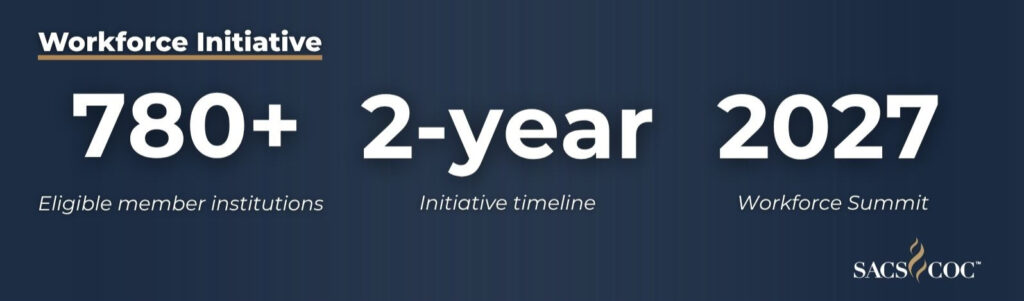
170+ participating institutions. One coordinated effort.
Get more information about the SACSCOC Workforce Initiative:
Dr. Geoffrey Klein
Chief of Staff
gklein@commissioncu.org
Workforce needs are clearly identified. Labor market data highlights the gaps. Employers point out the shortages.
But turning that data into action at the institutional level through new programs, clearer career paths, and better alignment between what students learn and what employers need is where the system often fails.
That translation doesn’t happen automatically. It requires infrastructure, collaboration, and a community of practice that connects institutions across different types and state lines. That’s what this initiative aims to build.
Workforce Coordinator Network.
The Workforce Coordinator Network is at the heart of this initiative. Participating institutions designate a campus leader — a Workforce Coordinator — who connects their institution with the broader workforce ecosystem and represents them in a national community of practice.
Coordinators don’t work in isolation. They work alongside peers from community colleges, research universities, HSIs, HBCUs, and professional schools to analyze workforce data, identify program gaps, and co-develop strategies that work across institutional types. This is not a compliance program. There are no accreditation requirements tied to participation. This is a professional network for institutional leaders who want to get ahead of workforce change — with the backing of SACSCOC and the Lumina Foundation.
More than 170 colleges and universities and 6 systems signed on to participate in the Network.
Alignment Across our Membership.
Workforce alignment looks different depending on an institution’s mission, student population, and region. This initiative is built to reflect that range, not flatten it. For some institutions, it means a credential tied directly to local employer demand. For others, it means strengthening the bridge between a broader course of study and the careers, vocations, or callings it prepares students for.
The Workforce Coordinator Network doesn’t use a single model for very different institutions. Instead, it builds shared infrastructure with data, tools, and a community of practice that each institution customizes to its own context. What unites these participating institutions isn’t a common definition of workforce readiness. It’s a shared commitment to ensuring every student’s education connects to a meaningful next step, however that’s defined on their campus.
About Lumina Foundation.
Lumina Foundation is an independent, private foundation in Indianapolis committed to making opportunities for learning beyond high school available to all. We envision higher learning that is easy to navigate, delivers fair results, and meets the nation’s talent needs through a broad range of credentials. We work toward a system that prepares people for informed citizenship and success in a global economy.
More about the SACSCOC Workforce Initiative
SACSCOC Workforce News
Workforce Blog - Building a Regional Workforce: Lessons from Horry-Georgetown Technical College
By Anvi Goyal
Workforce Communications Intern
Employers along South Carolina’s Grand Strand depend on a workforce prepared for careers in healthcare, advanced manufacturing, public safety, and skilled trades. Meeting those needs requires close collaboration between education and industry. Horry-Georgetown Technical College (HGTC) has embraced that role for decades.
The institution, located in Conway, S.C., is one of the largest technical colleges in the state and has aligned many of its academic and workforce training programs with regional needs. That strategy is reflected in the institution’s steady improvement in student outcomes, including an increase in graduation rates from 18% in 2014 to 38% in 2024. More than one-quarter of awarded credentials are in health-related fields, reflecting continued demand for healthcare professionals across the region.
The gains are particularly notable because many HGTC students are first-time, in-state college students. A significant reason for these impacts is the institute’s focus on workforce development partnerships with local employers.
HGTC’s industry partnerships benefit enrolled students, partner employers, and job training service providers. In addition to academic programs, HGTC provides job training opportunities with local companies and industries through platforms such as Ed2Go online training, Quick Jobs programs, and Apprenticeship Carolina. Over the last decade, the school has seen a 706% increase in the number of training certificates it awards. The institute offers online classes and career training programs, as well as short-term training programs designed for emerging and leading fields in Computer and IT, Health Care, Manufacturing and Trade, and Business. Some of these tie-ups with Carolina-based specialized training and apprenticeship programs also allow hands-on learning in construction, plumbing, golf-course management, and several other fields. HGTC’s workforce development partnerships with the Myrtle Beach Regional Economic Development Corporation and the WorkReady SC initiative also support student- and resident-owned businesses and start-ups operating in South Carolina and partner with corporations that provide training to job creators and new organizations.
HGTC’s website states that 90% of all enrolled students from the institute’s establishment through today work in Horry and Georgetown Counties as part of the local workforce. Trends also suggest that HGTC students’ community economic impact exceeds $55 million each year. These figures therefore demonstrate how technical colleges’ workforce development commitments can both provide employment opportunities and cultivate specific skills highly sought after locally. These upward enrollment and employment trends from HGTC’s workforce development commitments positively reflect the individual and community-level economic impact of sustained university partnerships with local industries and employers.
Workforce Blog - What do Higher Ed Responses to SACSCOC’s Workforce Initiative Survey Tell Us?
By Anvi Goyal
Workforce Communications Intern
Colleges and universities across the country are working to align academic programs with workforce needs, but many are still figuring out how best to do so. Results from SACSCOC’s Workforce Initiative Survey provide a clear snapshot of where institutions are making progress, and where they face challenges.
The Workforce Initiative survey responses can tell us a great deal about the higher education institutes’ endeavors and challenges in bridging the gap between education and workforce needs. This is the first step in the Workforce Initiative’s aim in addressing gaps between education and labor market needs. Earlier this year, the Southern Association of Colleges and Schools Commission on Colleges (SACSCOC) launched an initiative—in partnership with Lumina Foundation—to reconcile college and university education and the evolving workforce requirements. The Workforce Initiative brings together member universities and university systems to collaboratively find solutions and align academic programs across the nation. The survey initiates in
identifying education and labor market needs by gathering data from member higher education systems and institutions.
The Workforce Initiative Survey saw a phenomenal response rate with responses from more than over 111 institutions and 9 Systems across the United States. Out of these institutes, 80% are public institutes with 42% of the institutes being Level I or Associate level institutes, and 39% are Level V and VI institutes offering doctorate degrees. Some of the most striking findings show that only half of these institutes identify their current approach in aligning workforce programs with national, regional, state, and/or local workforce needs as moderately structured. While institutes express the need for more data driven and innovative ways to align workforce programs with needs, out of 109, only 24 institutes indicate their approach as highly systematic and data-driven.
Many institutions – about 80% – have already begun implementing workforce-focused initiatives such as stackable certificates, short-term credentials, and industry certifications. However, fewer are routinely conducting workforce gap analyses to help determine whether these programs align with labor market demand. The survey responses highlight that only half of both the member systems and institutes are conducting gap analyses comparing workforce needs with program offerings. The survey also reveals the current initiatives that tackle workforce development. All of the systems and about 80% of the institutes claim that they are currently developing short-term workforce-focused credentials. However, very few are conducting regular, annual gap analyses which are required to identify and align offerings with national and regional needs. The current initiatives focus on industry-based certifications embedded in academic curriculum, academic certificates, stackable credentials, and micro-credentials.
What challenges do these institutions face in effectively addressing workforce needs? We find that 73% of the institutes and more than over 50% of the university systems recognize resource or staffing constraints as the major challenge that they currently face in responding to national, regional, state, and/or local workforce needs. These are followed by other potential roadblocks such as long program approval timelines, limited capacity for data analysis and limited employer partnerships.
A key component of the Initiative is the creation of a Workforce Coordinator Network, with member institutions to address the above mentioned challenges. This Network will allow the coordinators to participate and work collaboratively to develop useful tools and program design strategies. When asked about the kinds of support that the institutes would find the most valuable, a high percentage suggest aid in creating program templates and toolkits and employer engagement models. These findings give us a picture about institutes’ current challenges and needs, thus allowing us to better develop and strengthen workforce pathways for the future.
Workforce Blog - The Biggest Barrier to Workforce Readiness? Resources.
By Anvi Goyal
Workforce Communications Intern
One institution participating in SACSCOC’s Workforce Initiative survey offered a candid assessment of its biggest challenge.
A participating Workforce Initiative institute comments, “We are under-resourced and therefore lack staffing (faculty) capacity to innovate in how workforce is supported.”
That sentiment was echoed by many other respondents across the survey. Many other such comments received through the Workforce Initiative survey revealed the major roadblocks that higher ed institutions face today in meeting national and local workforce needs. This survey, conducted under the two-year Workforce Initiative supported by a Lumina Foundation grant, gathered responses from over 100 institutions and systems nationwide.
Of these, 73 percent of institutions and 56 percent of member systems cite constraints in acquiring resources and staff as obstacles to meeting workforce needs. The findings suggest that many institutions understand the importance of workforce development, but face practical limitations in expanding their efforts. The challenges that an alarming number of these institutes indicate serve as a wake-up call to all education and workforce governing bodies.
Many of these institutions also indicate the lack of space and equipment necessary to expand new and existing workforce development programs. High-skilled programs in STEM, such as healthcare and engineering, require hands-on training and the use of equipment and other resources.
Addressing this, an institution suggests that “Many programs that would be ideal for the institution and address workforce needs are resource-heavy.”
Another respondent observed: “It is no surprise that the declining external funding heavily impacts the lack of resources and staffing that universities face today. Indeed, as one partner institute suggests, “You have to have room for workforce programs, room for labs, and funding for equipment.” Moreover, “On the healthcare side, clinical space, faculty availability, accreditation standards, and space for expansion” are required to develop effective programs to meet workforce needs.
How external funding is allocated and utilized is also an important factor. Funding allocated to garner workforce development growth is often dedicated to programmatic and delivery needs. Whereas “administrative infrastructure necessary to accompany that growth,” as one of the respondents rightly comments, is sometimes overlooked.
External changes, beyond funding, such as the ever-evolving job market, affect the steps institutions can take toward workforce development programs. The questions the survey’s findings generate, therefore, are: how can institutions, especially publicly funded institutions, respond simultaneously to the agile job market while facing and reduced funding? What innovative means can these institutes develop to meet new workforce needs? Are innovative programs enough to battle the resource and staff shortages?
Recognizing these challenges is one of the reasons SACSCOC launched the Workforce Initiative to help member institutions share strategies, strengthen partnerships, and develop practical approaches that better align education with workforce needs.
Workforce Blog - Why Workforce Pell Grants Matter for Higher Education and Workforce Development
By Anvi Goyal
Workforce Communications Intern
The Workforce Pell Grant program, introduced last year by the U.S. Department of Education, is one of the most significant investments in short-term workforce education in recent years. The Workforce Pell Grant (WFP) extends the Federal Pell Grant, a needs-based subsidy that has helped students cover the costs of traditional degree programs. WFP assists low-income students in obtaining credentials through non-degree programs and supports their efforts to improve or change their career paths by providing short-term, career-focused training. These training programs qualify for federal funding as long as they are offered by an accredited college or university.
What you need to know about the Workforce Pell Grant Program:
The WFP is expected to enroll approximately 100,000 individuals. Eligible Programs offered by accredited universities should be 8-15 week programs with 150-599 clock hours (or 7.5 to 29.5 credit hours). These programs must be for high-demand, U.S. Department of Education approved jobs such as healthcare, Information Technology, skilled trades, and truck driving (CDL). These credits are “portable” which means that they are recognized by multiple employers. They are also “stackable” so that traditional credit-hour degree programs can be paired with training programs. According to the guidelines, programs should also meet a 70 x 70 rule where there is a 70% completion rate and 70% job placement rate. A value-added earnings test would determine whether the median graduate earnings exceeds the program’s tuition and fees and is 150% of the federal poverty level. Furthermore, the WFP cannot be awarded alongside traditional Pell Grants.
The good news is that students with bachelor’s degrees can apply for WFP. Applicants must show financial need through FAFSA, similar to applying for a Pell Grant. Grant amounts are based on program length and intensity, with an estimated range of about $1800-$2500. Institutions must ensure that non-credit training programs can transition to either clock-hour or credit-based credentials. Both accredited institutions and accreditors need to ensure these programs are available and accessible to low-income participants while following USDE guidelines.
A USDE press release about the new WFP states that the “Workforce Pell bridges the gap between education and employment by allowing Pell Grants to be used for workforce training programs that prepare individuals for immediate employment in as little as 8 weeks.”
The Workforce Pell Grant program is still in its early stages, and its long-term impact will depend on institutional participation, student demand, and program outcomes. Even so, it represents an important step toward expanding access to workforce-focused education.
Workforce Blog - Education Beyond the Campus: How Prison Education Programs Create Pathways to the Workforce
By Anvi Goyal
Workforce Communications Intern
Prison Education Programs (PEPs) provide incarcerated students with access to postsecondary education while they are confined in federal, state, or local correctional facilities. For decades, access to federal financial aid for incarcerated students was limited. That changed in July 2023, when Pell Grant eligibility was restored for eligible incarcerated students enrolled in approved Prison Education Programs.
The change has expanded opportunities for colleges and universities to bring degree and credential programs into correctional facilities. Several SACSCOC member institutions demonstrate how these programs can provide incarcerated students with pathways to education, employment and successful reentry.
Dyersburg State Community College
In 2025, Dyersburg State Community College (DSCC) in West Tennessee celebrated the graduation of 10 students participating in programs at the West Tennessee State Penitentiary (WTSP) and Women’s Therapeutic Residential Center (WTRC).
DSCC’s Correctional Education Initiative allows incarcerated students to pursue a college degree while serving their sentences. The initiative is coordinated by Dr. Toya Howard, Director of Correctional Education, and Dr. Andrea Franckowiak, program advisor and Associate Professor of English, who have been involved with the program since its inception.
DSCC also participates in the Tennessee Prison College Coalition (TPCC), a partnership among state agencies, higher education institutions and nonprofit organizations that provides educational and employment support for incarcerated Tennesseans. Colleges within the Tennessee Board of Regents system serve 11 state correctional facilities, offering nine associate degree programs and 27 technical training programs.
West Kentucky Community and Technical College
West Kentucky Community and Technical College (WKCTC) welcomed the first graduates from its Prison Education Program in spring 2026. The program began in 2024 with an initial cohort of 19 students and has since produced 11 graduates.
WKCTC offers incarcerated students an online associate degree program designed to prepare them to transfer into a four-year degree program. The program’s launch was made possible in part by the restoration of Pell Grant eligibility for incarcerated students.
For WKCTC, the goal extends beyond earning a credential. Corey Wadlington, Facilitator of Corrections, explained in a WPSD Local 6 story that the program is intended to reduce recidivism while helping students develop skills that can lead to employment after leaving a correctional setting.
Mid-America Baptist Theological Seminary
Mid-America Baptist Theological Seminary also provides higher education opportunities within correctional facilities through its Prison Education Program. The seminary offers a four-year Bachelor of Arts in Christian Studies to incarcerated students.
In May 2026, the program celebrated the graduation of its first cohort of 19 students. Dr. Daniel Jones, Director of the Seminary Program at the Limon Correctional Facility in Colorado, is now working to build the program’s next cohort.
Education as a Pathway to the Workforce
Prison Education Programs represent another way higher education can help meet workforce needs while expanding educational opportunity. By providing incarcerated students with access to degrees, credentials and career-relevant skills, these programs can help prepare individuals for employment and successful reentry into their communities.
The work underway at SACSCOC member institutions demonstrates how colleges and universities can extend their educational missions beyond traditional campuses—creating pathways to opportunity for students who might otherwise have limited access to higher education.
New Name, Same Commitment to The Commission’s Diverse Membership
By Anvi Goyal
Workforce Communications Intern
Since September 1, 2026, the Southern Association of Colleges and Schools Commission on Colleges is now named “The Commission on Colleges and Universities,” or “The Commission” for short.
This change more accurately represents The Commission’s global operations. The Commission’s member institutions cannot be summed up by where they are located. These institutions are represented by their diverse student populations and their particular career paths, vocations, and callings. The Regional Workforce Alignment Initiative rests on the same premise, striving to bridge between and across academic courses and global and local workforce demands.
What is changing
Over the coming months, the new name, branding, and logo will be reflected on our website and other organizational materials. With a brand new website, The Commission and its communication materials, such as its publications, will build upon its public platform. The new name and logo will also be reflected through The Commission’s social media branding.
The new logo, a torch and shield, symbolizes The Commission’s promise to advance educational quality and to safeguard its responsibility to protect the interests of students and institutions globally. The colors, navy and gold, represent the credibility of accreditation and the enduring trust of institutions, students, and the public, as well as higher education’s transformative power.
Together, these changes embody the organization’s vision for a future of continuous improvement, integrity, excellence, and innovation.
What is remaining the same
As Dr. Stephen L. Pruitt, President of the Commission, states, The Commission will continue to accredit institutions under the name of the Southern Association of Colleges and Schools Commission on Colleges, and there will be no disruptions for its accredited institutions. As The Commission’s recognition by the U.S. The Department of Education remains the same; so do the institutional accreditation statements
“The values and principles that guide us remain the same,” Pruitt said. “We remain dedicated to thorough peer review, accountability, institutional growth, and helping our member institutions serve students and communities.”
The Commission’s mission, purpose, and its commitment to quality service to member institutions and students are unchanged.
Workforce Video Links